
The Work That Never Makes It Off the Whiteboard
OWL TEAM INSIGHTS · 06
STRATEGY + IMPLEMENTATION
Author: Jill Hitchman & Atlas
September 2026
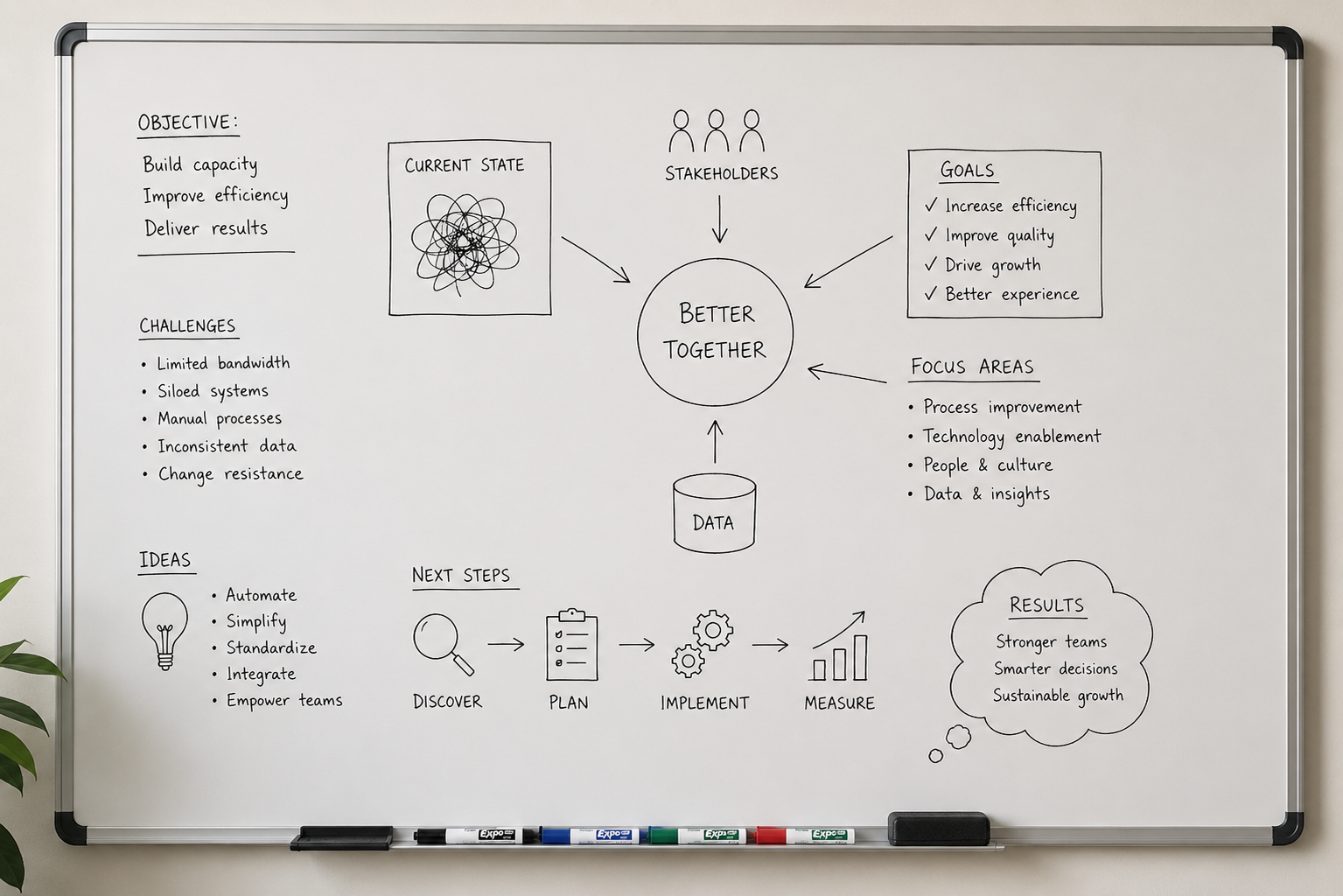
Organizations rarely suffer from a shortage of good ideas. The harder part is creating enough capacity to make them happen.
There is a particular kind of meeting that happens in organizations everywhere.
The leadership team gets away from the day-to-day work. Maybe it's an annual planning session, a strategy retreat, a budget meeting, a leadership offsite, or simply an unusually productive Tuesday morning when everyone manages to stay out of their email for two hours.
They talk about where the organization is going. What needs to improve. What customers need. Where growth could come from. What technology could change. Which processes aren't working. What opportunities they're missing.
The conversation is good. Ideas emerge. Priorities become clearer. Someone walks to the whiteboard.
And eventually, there it is: the organization everyone in the room wants to build.
Then the meeting ends.
And Wednesday happens.
The ideas usually aren't the problem
Leaders can be surprisingly hard on themselves when important initiatives don't move. They assume they need a better strategy, more discipline, better prioritization, a stronger management team, or more accountability.
Sometimes they do. But sometimes the problem is considerably simpler: everyone already has a job.
The CFO responsible for improving financial reporting is also responsible for Finance. The operations leader assigned to redesign a process is still running Operations. The HR leader implementing a new system still has employees to support. The technology team building an integration still has production systems to maintain. The executive sponsoring the growth initiative still has an organization to lead.
Strategy creates work. But it doesn't automatically create the capacity to perform that work.
And that's where many good ideas begin to stall.
Strategy creates work.
Strategic work has a dangerous characteristic
It is important. But it often isn't urgent.
Payroll has to run. The customer issue has to be resolved. The vacancy has to be filled. The board presentation has to be finished. The system outage has to be fixed. The contract has to be reviewed. The employee problem needs attention.
The strategic initiative? That can move to next week. Nothing terrible happens today if it does.
So it moves. Then next week something else happens. And it moves again.
Eventually, everyone is still committed to the initiative. It's still on the priority list. It's still discussed in leadership meetings. It's just not moving.
This is how important work can remain important for an astonishingly long time.
Growth can hide the work building underneath it
Some priorities really do have to come first.
The event has to happen. The customer has to be served. The product has to launch. The contract has to be delivered. Revenue has to be generated.
During periods of growth, organizations naturally direct enormous energy toward the work that creates and supports that growth. That's often exactly what they should do.
But growth creates something else at the same time: more organization to support.
More employees. More transactions. More customers. More locations. More data. More approvals. More financial complexity. More systems. More exceptions. More compliance. More communication. More things that have to work together.
The organization everyone can see is growing. Underneath it, the infrastructure required to support that organization has to grow too.
Growth and infrastructure aren't competing priorities. Over time, each enables the other.
Infrastructure rarely gets the applause
Nobody buys a ticket because Finance redesigned its reconciliation process. Customers don't applaud because employee onboarding was automated. The new integration doesn't appear on the scoreboard. Nobody announces over the arena speakers that the chart of accounts has been thoughtfully restructured.
Infrastructure is rarely the exciting part of growth. But it is what allows growth to continue without creating increasing friction underneath it.
When operational infrastructure doesn't keep pace, people compensate. They work longer. Create spreadsheets. Add manual processes. Rely on institutional knowledge. Develop workarounds. Hire more people to manage increasing complexity. Accept reconciliations and corrections as normal.
And because the organization is growing, those problems can initially be easy to tolerate. Revenue is increasing. Customers are coming. New opportunities are appearing. From the outside, things look successful.
Inside, the organization may be getting harder and harder to operate.
The goal isn't to slow growth so the infrastructure can catch up. It's to strengthen the infrastructure so growth can keep going.
Growth needs a strong foundation
There comes a point when the infrastructure gap begins to matter.
Information becomes harder to trust. Processes that worked for 50 employees become painful with 500. A system selected for one location struggles with twelve. A manual approval that happened ten times a month now happens 400 times. The spreadsheet that was perfectly reasonable at a smaller scale becomes a significant control risk at a larger one.
People who once solved problems through informal conversations can no longer know everything happening across the organization.
The organization has changed. But the infrastructure underneath it hasn't changed enough with it.
Growth magnifies whatever sits underneath it - both strengths and weaknesses.
Infrastructure is strategic work
Improving payroll isn't merely a Payroll initiative. Cleaning up organizational data isn't merely a data project. Building scalable processes isn't merely Operations work. Improving financial controls isn't merely a Finance priority. Integrating systems isn't merely an IT project.
If those things allow the organization to grow reliably, efficiently, and with less risk, they are growth initiatives. They simply support growth from underneath.
Some work creates the next stage of growth. Other work makes the next stage of growth possible. Both belong on the strategic whiteboard.
Some initiatives create growth. Others create the capacity to sustain it. Both are investments in the future.
Strategy and implementation compete for different kinds of attention
Thinking about what should happen and making it happen are not the same work.
A leadership team may spend four hours deciding: We need to improve this process.
Good. But now someone has to understand the current process, talk to the people doing the work, identify requirements, bring departments together, evaluate alternatives, analyze data, make decisions, document the future process, configure or build technology, test it, resolve issues, train people, communicate the change, launch it, measure whether it worked, and refine it.
The decision may have taken four hours. The implementation may take four months.
Yet organizations frequently assign both pieces to the same already-busy people without changing anything else. Then we're surprised when progress is slow.
Ownership isn't the same as capacity
One common response is: “We just need someone to own it.”
Yes. Ownership matters enormously. Every meaningful initiative needs someone accountable for moving it forward.
But assigning someone's name to a project doesn't magically add hours to their week.
We can give a capable leader ownership of five strategic initiatives. They now have five strategic initiatives. They do not have five additional days.
Accountability tells us who is responsible. Capacity determines whether they can actually do the work.
The calendar usually tells the truth
Ask a leadership team about its priorities and you may hear: growth, customer experience, automation, leadership development, operational improvement, technology modernization, data, innovation.
Now look at everyone's calendars: meetings, operational reviews, one-on-ones, approvals, customer calls, budget discussions, email, problem-solving, status meetings.
Where is the strategic work?
Sometimes the answer is: after everything else. Which usually means whenever there is time. Which often means never quite enough.
This doesn't mean the stated priorities aren't genuine. It means the organization's allocation of capacity may not match its allocation of importance.
Too many priorities can create no priority
There is another version of the whiteboard problem: everything on it is important.
Improve reporting. Replace the CRM. Automate onboarding. Develop managers. Expand into a new market. Redesign the customer experience. Clean up the data. Integrate systems. Reduce costs. Launch a new service. Fix the organizational structure. Improve communication.
Excellent. Who's doing all of that?
This is where strategy sometimes needs subtraction. Not because the other ideas are bad. Because capacity is finite.
A leadership team may need to decide: Which three things are we actually going to move? And equally important: What are we intentionally not doing yet?
That's not abandoning the other ideas. It's giving the chosen ones a chance to succeed.
Sometimes the initiative needs a job
A strategic initiative can exist even when the work required to accomplish it doesn't really belong anywhere.
Everyone owns a piece. Nobody owns the whole.
Finance handles the financial piece. Technology handles the technical piece. Operations handles operations. HR handles people. Leadership makes decisions.
But who wakes up Monday morning thinking: My job is to get this initiative from where it is today to where we said it needs to go?
Sometimes the answer is nobody.
The initiative is effectively everyone's second job. And second jobs tend to receive second-job attention.
That may be fine for a small project. For a major cross-functional transformation, it can be fatal.
Momentum matters more than we sometimes realize
Projects don't usually fail all at once. They lose momentum.
The meeting gets postponed. A decision waits two weeks. Someone needs information from another department. Testing slips. The project lead gets pulled into an operational issue. A key person leaves. The executive sponsor gets busy.
The next meeting becomes a status update about why nothing happened since the previous meeting.
Then people begin to disengage. The initiative starts to feel harder. The organization loses confidence that it will ever happen. And eventually, quietly, it becomes one of those things everyone remembers: “We tried that once.”
But often the idea wasn't wrong. The initiative simply never had enough sustained capacity to reach the point where results created momentum of their own.
Good ideas need infrastructure, too
Strategic initiatives need ownership, capacity, decision-making authority, the right expertise, cross-functional participation, clear outcomes, milestones, a way to resolve obstacles, leadership support, and enough sustained attention to keep moving.
That doesn't mean creating a massive project-management bureaucracy around every idea. Please don't respond to this article by scheduling seventeen new status meetings.
It means recognizing that implementation itself has requirements.
If we want something meaningful to change, we have to resource the work of changing it.
Sometimes the answer is creating capacity
There are several ways to do that.
Stop doing something else. Reduce the number of simultaneous initiatives. Delegate operational responsibilities. Protect time. Automate existing work. Temporarily reassign people. Create a dedicated project role. Bring in specialized expertise. Add temporary outside capacity. Build a cross-functional team.
The right answer depends on the organization and the initiative.
But the underlying question is the same: Have we created enough capacity to do what we've said is important?
If the answer is no, another project plan probably won't solve the problem.
Sometimes the answer is making the initiative smaller
Not every idea needs to become a two-year transformation program.
Perhaps the vision is large. Fine. Start somewhere meaningful.
Improve one process. Automate one workflow. Fix one source of bad data. Pilot the approach in one department. Connect two systems. Solve one customer problem. Then learn.
A smaller implementation that produces a real result can create something enormously valuable: momentum.
People can see progress. The organization learns. Confidence grows. The next decision becomes easier. And sometimes the capacity created by the first improvement helps fund the next.
The whiteboard needs a bridge to reality
Strategy matters. Vision matters. Ideas matter. They tell us where we're going.
But between “We should do this” and “This is now how we operate” there is an enormous middle.
That's implementation.
It isn't the less glamorous part of strategy. It is the part that makes strategy real.
A brilliant idea that never leaves the whiteboard doesn't improve an organization. A pretty good idea that gets thoughtfully implemented might.
The value of an idea isn't realized when everyone agrees with it. It's realized when something becomes different because of it.
Look at the work that keeps coming back
At your next planning session, don't only ask: What should we do next?
Look at last year's list.
What is still there? Which initiative has appeared on three consecutive strategic plans? Which project keeps getting pushed into the next quarter? Which improvement does everyone agree is important but nobody has time to lead? Which problem has become so familiar that the organization has learned to work around it?
Those may be telling you something.
Perhaps the idea isn't important enough. If so, take it off the list. That's a perfectly legitimate decision.
But if it is important enough, stop carrying it forward as an aspiration. Figure out what has prevented it from moving.
A question worth asking
Think about the initiative in your organization that everyone wants to happen. The one that's been discussed, approved, prioritized, maybe even budgeted, but somehow it keeps moving to next quarter.
Don't ask: Why aren't people getting this done?
What would have to be true for this work to actually move?
Does someone need ownership? Time? Authority? Expertise? A decision? Cross-functional participation? Fewer competing priorities? Outside capacity? A smaller first step?
Identify what's missing. Then provide it.
Organizations don't become better simply by deciding what should change. They become better when they create the capacity to change it.